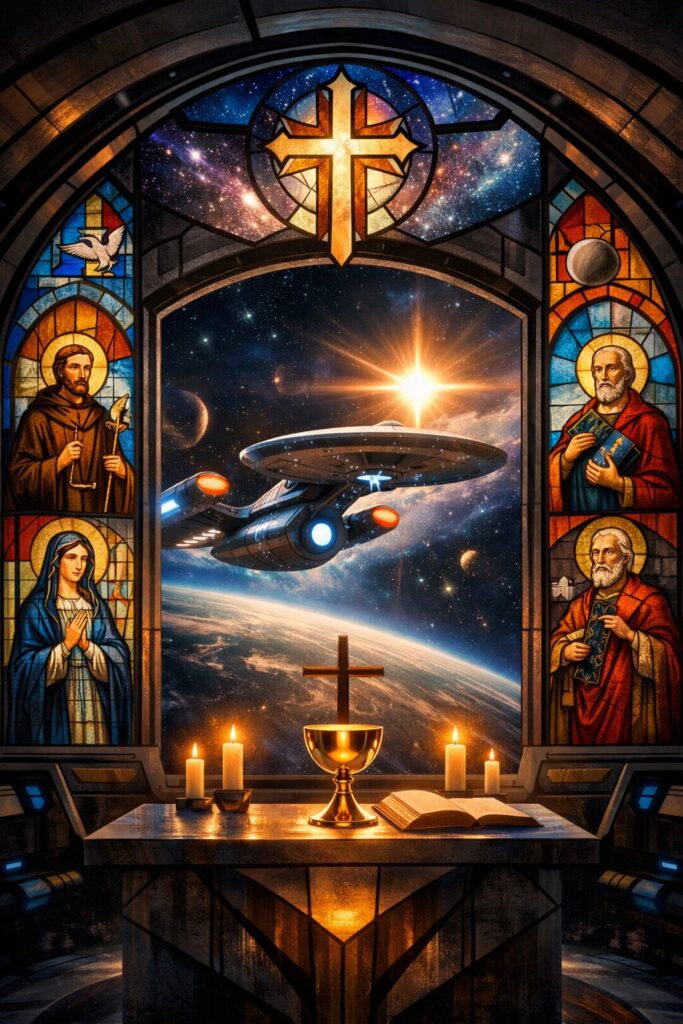
Introduction: A Federation Imagination and an Ecclesial Disappointment
I grew up with Star Trek before I had language for ecclesiology. Before I knew the word sacrament, I knew that bridges were places where diverse beings sat in communion. Before I knew the term magisterium, I knew that truth was discovered through counsel, conscience, dialogue, and exploration. Before I ever read Paul’s metaphor of the Body with its many members (1 Cor 12:12–31), I watched a Tellarite, a Vulcan, and a Human argue in the briefing room, not to win but to understand (TOS: “Journey to Babel,” S2E10). Without intending to, Trek catechized me into the notion that mature authority serves dignity rather than enforcing conformity.
So when I encountered the Church—first through inherited denominational structures and later through more formal sacramental pathways—I came expecting something much closer to the United Federation of Planets than to the Klingon High Council. I expected a world where unity did not require uniformity, where conscience mattered, where ecumenism was diplomacy and not suspicion, where sacrament was hospitality rather than leverage, and where exploration was itself a form of reverence.
What I found, instead, was a Christianity fractured along familiar galactic lines: Empires, Republics, Protectorates, Neutral Zones, splinter cells, isolated monasteries, experimental communities, and a scattering of refugees looking for somewhere their souls could dock without being boarded by customs officials.
It took me years to realize that the Church I was looking for existed—but not in the traffic lanes of the major powers. It existed on the frontier. And it had a name: the Independent Sacramental Movement.
I. The Federation as Communion-With-Difference
The Federation is not a monoculture. Vulcans do not become Humans, Andorians do not become Bolians, and nobody forces Tellerites to be polite. The Federation is held together by a binding set of principles—mutual dignity, diplomatic cooperation, and shared advancement of knowledge—and yet each member world retains its own rituals, cosmologies, and identities.
This is why the Federation has always felt ecclesiological to me. It is a polity of communion, not conquest. In The Drumhead (TNG S4E21), Picard warns that fear pushes societies from discernment toward uniformity, and from uniformity to authoritarianism. The Federation resists that impulse because it assumes that sentient life flourishes through difference.
The early Church operated on something much closer to that model than most Christians remember. The Churches of Antioch, Alexandria, Rome, and Jerusalem did not begin as identical franchises of a central office. They were more like distinct planetary cultures bound by a shared confession and a shared sacramental imagination. Communion meant that bread was broken across difference, not that difference was broken to make uniformity possible.
When I first learned about the Federation’s Prime Directive (General Order 1)—the refusal to impose development models on emerging cultures—it struck me as strangely parallel to conscience as a theological principle. Grace does not need coercion. The Spirit does not require assimilation. The early Christian refusal to force gentile converts to adopt the full Torah (Acts 15:1–29) was itself a kind of proto–Prime Directive: the Gospel was not a cultural annexation project.
II. Institutions, Empires, and the Weight of Uniformity
But ecclesial institutions, like galactic powers, have gravitational tendencies. They centralize, calcify, defend, secure, and reinforce themselves. Rome became Rome; Constantinople became Constantinople. Polity hardened into canon law. Recognition became currency. Apostolic succession became border control. Validity became passports. Communion became diplomatic treaties.
In Trek, great powers exert similar force. The Klingon Empire values honor, bloodlines, and martial lineage over diplomacy (TNG: “Sins of the Father,” S3E17). The Romulan Star Empire embodies secrecy, intelligence, and hierarchical mystique (TNG: “The Enemy,” S3E7). The Cardassians represent a state apparatus that prioritizes order and loyalty over dissent (DS9: “Cardassians,” S2E5). Each power believes its own coherence requires the suppression of difference.
Many ecclesial institutions do the same—not out of malice, but out of survival instinct. Structures protect themselves. Theologies fortify borders. Sacraments become regulated commodities, and pastoral access becomes a matter of jurisdiction rather than spiritual need.
For laypeople, this often appears as inconsistency. For clergy and spiritual seekers, it often feels like being told that warp travel is only legal if one uses the officially sanctioned warp corridor—regardless of where conscience is leading.
III. Discovering the Movement on the Frontier
The Independent Sacramental Movement (ISM) does not exist inside the empires. It exists in the frontier territories—the Badlands between Alpha and Gamma Quadrants where minor powers, exiles, idealists, and spiritual scientists build communities without waiting for the Federation Council to approve their warp core designs.
I came to the ISM the way many do: by realizing that sacramental life, pastoral access, and authentic vocation were not luxuries reserved for citizens of major ecclesial powers. There are Christians who love the sacraments, who believe in the dignity of all people, who desire catholicity without imperialism, and who cannot fit into institutions that have grown too large, too specialized, or too optimized to notice the ones who fall outside their lanes.
When I discovered Old Catholic and Independent Catholic communities, it felt like I had stumbled onto Deep Space Nine for the first time: a station built on contested space, full of diplomats, merchants, monks, soldiers, prophets, refugees, and pilgrims. DS9 was never sanitized like the Enterprise-D. It was a “frontier Church” of its own—where Federation idealism met Bajoran spirituality, Cardassian geopolitics, Ferengi pragmatism, and wormhole theology.
If TNG imagined the Church as a university monastery, DS9 imagined it as a port city with a shrine.
The ISM is more DS9 than Enterprise. It is messy, human, relational, experimental, often under-resourced, and filled with characters who would make Quark very comfortable. But it is also a place where sacraments happen, where seekers find welcome, and where the Spirit does not wait for committees to finish consulting their legal team.
IV. Theological Expansion
A. Sacramentology: Grace Without Empire
Independent Sacramental communities operate from a deeply catholic sacramentology: the belief that God’s grace is mediated through visible signs, real rituals, tactile symbols, and embodied encounter. The ISM does not reject sacrament—it rejects the monopolization of sacramental access.
In the major churches, sacraments often function like Federation technology transfer protocols—regulated, licensed, sometimes restricted, and always subject to institutional mediation. But grace is not a proprietary technology. Jesus did not charge docking fees at the table of the Last Supper.
In my journey, sacrament became less about authorization and more about availability. A Church that withholds grace from those who desire it is like Starfleet refusing medical aid to a civilian ship because its paperwork is incomplete.
The ISM assumes that the sacraments derive their power from Christ, not from licensing agreements between bishops.
Grace does not require recognition to be real. Recognition is simply a diplomatic category; grace is a theological one.
B. Polity: Conscience as Governing Principle
Ecclesial polity is where Trek analogies shine brightest. The major churches operate more like empires, patriarchates, and synods. The ISM operates more like Starfleet: shared mission, diverse jurisdictions, distinct charisms, and overlapping diplomacy.
Starfleet officers do not always agree. Kirk governs by instinct, Picard by reason, Janeway by resolve, and Sisko by vocation. And yet they all wear the uniform and serve the Federation.
Similarly, the ISM includes:
- Old Catholic dioceses (structured, liturgical, diplomatic)
- Liberal Catholic synods (mystical, theosophical, esoteric)
- Independent Orthodox bodies (patristic, sacramental, ascetical)
- Gnostic churches (esoteric, initiating, catechetical)
- Charismatic apostolic communities (Spirit-driven, healing-oriented)
- Interspiritual communities (ecumenical, contemplative, boundary-crossing)
If Rome is the Klingon Empire and Orthodoxy the Vulcan High Command, the ISM is Starfleet Academy on a civilian campus: diverse, argumentative, inquisitive, and often united only by the assumption that conscience and sacrament must never be divorced.
C. Charisms: Ministries Beyond the Major Powers
The ISM is where spiritual gifts that do not fit into denominational job descriptions find form: healers, chaplains, mystics, theologians, catechists, poets, monastics, activists, counselors, contemplatives, and prophets. The major powers often need clergy who can run dioceses; frontier space needs clergy who can run infirmaries, taverns, and temporary chapels.
D. Pneumatology: The Spirit as the Wormhole
In Trek terms, the Holy Spirit is not warp drive—it is the Wormhole. Warp drive is technology; the Wormhole is encounter. The Wormhole in DS9 connects worlds, times, destinies, and vocations. It cannot be regulated by Federation treaties. The Prophets are not bound by Starfleet protocols.
Likewise, the Spirit unites Christians across jurisdictional lines. Pneumatology is the antidote to ecclesial imperialism.
V. Trek Parallels to Ecclesial Families
These analogies are imperfect but illuminating:
- Old Catholicism = Bajor
ancient, wounded, spiritual, liturgical, post-occupation, negotiating sovereignty - Roman Catholicism = Klingon Empire/Romulan Empire (depending on era)
lineage, hierarchy, honor, structure, secrecy - Orthodoxy = Vulcan Civilization
contemplative, ascetic, ancient, philosophical, liturgical precision - Liberal Catholicism = Trill Symbiosis Commission
mystical, incarnational, multi-life, esoteric depth - Gnostics / Esoteric Christians = El-Aurians
listeners, interpreters, survivors of spiritual cataclysm - Interspiritual Communities = Federation Diplomatic Corps
liaison-oriented, bridge-building, cosmopolitan - Evangelicals = Maquis / Planetary Insurrectionists (depending on flavor)
decentralized, passionate, populist, sometimes resistant to central authority
The ISM is not one of these factions. It is the space where these factions negotiate within a shared sacramental grammar.
VI. The Wounds and the Work
Arriving in the ISM is often preceded by wounding: ecclesial exile, spiritual displacement, identity conflict, or vocational frustration. Some people arrive because they were pushed out. Others arrive because they were overlooked. Still others arrive because they refused to participate in systems that made them complicit in diminishing the dignity of another.
In Trek, the Federation frequently shelters the displaced. In Ensign Ro (TNG S5E3), Ro’s Bajoran identity puts her at odds with Starfleet’s expectations. Picard eventually learns that compassion requires listening rather than regulation. The Church needs more Picards and fewer Admirals.
The ISM exists because grace should not require a membership card. People need sacraments. People need community. People need to confess and to be absolved. People need Eucharist more than they need brand recognition.
VII. Roddenberry, DS9, and Theology
Gene Roddenberry envisioned a future where humanity matured beyond tribalism, fear, and domination. His was a humanist eschatology. But DS9 added something Roddenberry initially resisted: religion. Sisko is not just a commander; he is the Emissary. The Prophets are not merely aliens; they are metaphysical intelligences. Bajoran faith is not reduced to superstition; it is treated with dignity (DS9: “In the Hands of the Prophets,” S1E20).
DS9 acknowledges what Roddenberry didn’t: that spiritual consciousness is not a mark of primitive cultures but a mark of depth. Where Roddenberry offered secular hope, DS9 offered theological meaning.
Christianity must learn the same lesson. It cannot survive as an empire, but it might flourish as a Federation.
VIII. Where I Am Now: Life on the Frontier
Today, I live ecclesially closer to DS9 than to the Enterprise. I serve in spaces that feel like docking rings, refugee camps, chapels, and embassies. My spiritual community is not large, but it is alive. It is sacramental without being imperial. It is catholic without being colonial. It is catholic in the older sense—kat’holos, “according to the whole”—without requiring uniform compliance to a single ecclesial center of gravity.
There is still longing in me—for unity, for recognition, for catholicity fully realized. But there is no shame. Exile is not always punishment. Sometimes exile is vocation.
Conclusion: A Final Exhortation for All Who Travel These Quadrants
To the clergy and ministers of the ISM:
Do not abandon sacrament.
Do not abandon beauty.
Do not abandon catholicity.
You are not an accident of history; you are a frontier outpost of grace. Keep your altars open. Keep your vocations honest. Keep your hospitality fierce.
To the major churches and ecclesial institutions:
Do not fear the frontier. The frontier is where the Gospel has always thrived. You do not lose authority by sharing sacrament; you lose authority by hoarding it.
To the spiritual seekers who read this wondering if they belong:
You do. You belong before you believe. You belong before you understand. You belong before anyone hands you a certificate of membership. God is not a border agent, and grace is not customs paperwork.
To the general public, who watch the Church from a distance the way some watch the stars:
Do not confuse empire with faith or bureaucracy with God. There are Christians building communities that look more like the Federation than like the Klingon High Council.
To all:
The Church does not need to conquer to be catholic.
It does not need to assimilate to be unified.
It does not need to standardize to be holy.
As Picard reminds us:
“We work to better ourselves and the rest of humanity.” (TNG: “First Contact,” film)
That is as close to a Christian ethic as you will find in secular science fiction. And as Sisko tells the Prophets near the end of his journey:
“I exist because of you.” (DS9: “What You Leave Behind,” S7E25–26)
We exist because of God.
The frontier remains.
The Spirit still explores.
To seek out new life and new civilizations was always, at its heart, a theological mission.
The Church would do well to remember that.
Amen.